Building Resilient Microservices with Go and gRPC
Hoàng Ngô Anh Đức·
28/05/2026 02:12
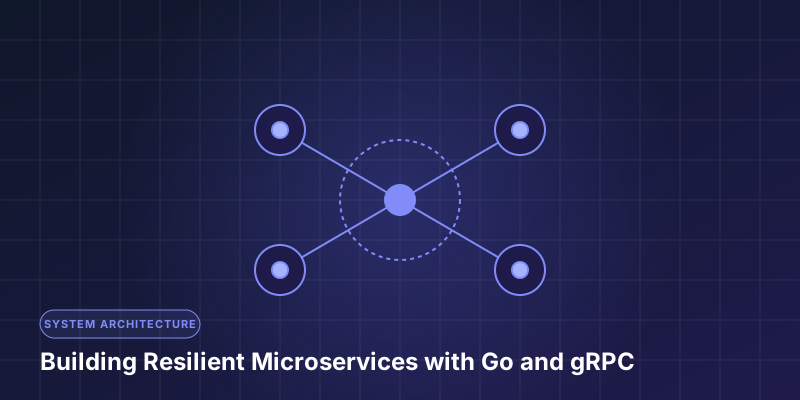
When designing modern cloud architectures, communication efficiency between microservices is a primary bottleneck. Traditional JSON-over-HTTP REST APIs are simple, but they suffer from high serialization overhead and heavy CPU usage.
By switching to **gRPC** and **Protocol Buffers (Protobuf)**, we can achieve up to **10x higher throughput** and incredibly low latency. Let's dive into how to build resilient services in Go using gRPC!
### Why gRPC?
gRPC uses **HTTP/2** as its transport layer, which unlocks three massive features:
1. **Multiplexing:** Send multiple requests and responses over a single TCP connection, eliminating head-of-line blocking.
2. **Binary Framing:** Protobuf encodes messages into a compact binary format rather than human-readable text. It is drastically faster to serialize/deserialize.
3. **Bi-directional Streaming:** Send streams of messages concurrently between client and server over a single persistent connection.
### 1. Defining the Protobuf Contract
A robust architecture always begins with a clear, strictly-typed API contract. Let's define our service in a `.proto` file:
```protobuf
syntax = "proto3";
package analytics;
option go_package = "analytics/v1;analyticsv1";
message TrackEventRequest {
string event_name = 1;
string user_id = 2;
int64 timestamp = 3;
map properties = 4;
}
message TrackEventResponse {
bool success = 1;
string error_message = 2;
}
service AnalyticsService {
rpc TrackEvent(TrackEventRequest) returns (TrackEventResponse);
rpc StreamEvents(stream TrackEventRequest) returns (TrackEventResponse);
}
```
### 2. Implementing the Server in Go
In Go, we generate our boilerplate code using `protoc` and implement the generated interface. Here is how we set up a high-performance gRPC server:
```go
package main
import (
"context"
"fmt"
"log"
"net"
pb "analytics/v1"
"google.golang.org/grpc"
)
type analyticsServer struct {
pb.UnimplementedAnalyticsServiceServer
}
func (s *analyticsServer) TrackEvent(ctx context.Context, req *pb.TrackEventRequest) (*pb.TrackEventResponse, error) {
// Process event concurrently
log.Printf("Received event: %s for user: %s", req.EventName, req.UserId)
return &pb.TrackEventResponse{Success: true}, nil
}
func main() {
lis, err := net.Listen("tcp", ":50051")
if err != nil {
log.Fatalf("failed to listen: %v", err)
}
grpcServer := grpc.NewServer()
pb.RegisterAnalyticsServiceServer(grpcServer, &analyticsServer{})
fmt.Println("gRPC Server listening on port :50051")
if err := grpcServer.Serve(lis); err != nil {
log.Fatalf("failed to serve: %v", err)
}
}
```
### 3. Adding Resiliency (Retries and Timeouts)
Resiliency is non-negotiable in production. A single lagging service can cascade and take down your entire application. Always enforce client-side deadlines:
```go
ctx, cancel := context.WithTimeout(context.Background(), 200*time.Millisecond)
defer cancel()
resp, err := client.TrackEvent(ctx, &pb.TrackEventRequest{...})
```
By enforcing a strict **200ms timeout**, we prevent requests from hanging indefinitely and backing up server resources.
// Read next
Related articles
Modern Headless CMS Architectures: Best Practices
Understand the decoupled web architecture. Explore how headless CMS systems power rapid multi-channel content delivery w...
Mastering SQLite for Production Web Applications
Think SQLite is just a toy database? Think again. Learn how to configure WAL mode, handle locking, and scale SQLite to m...
Architecting High-Performance API Gateways in Go
Learn how to design a blazing fast API gateway in Go. Implement the token bucket rate-limiting algorithm, reverse proxie...
// Reader response
Comments
This article has no comments yet.
// Author
Hoàng Ngô Anh Đức
Software Engineering Student & Junior Full-Stack Developer
Tôi đang học Software Engineering tại RMIT University Vietnam, có 4 năm học tập tại Canada và kinh nghiệm làm việc remote với các tổ chức Canada. Tôi tập trung xây dựng sản phẩm web thực tế bằng Go, Vue, TypeScript và SQLite.