Modern Headless CMS Architectures: Best Practices
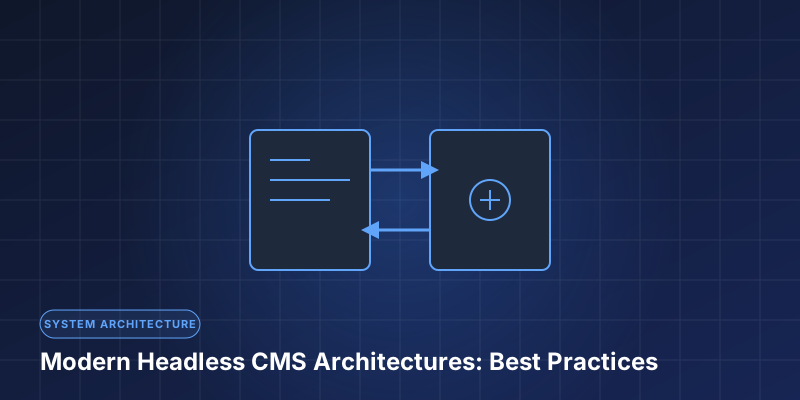
The era of monolithic web systems like classic WordPress is fading. Modern engineering teams prefer **decoupled (headless) architectures**, separating the content creator's administrative dashboard from the public-facing interface.
This decoupling gives developers total freedom to select modern, fast frontend frameworks (like Vite, Vue 3, Nuxt, or Next.js) while keeping the database server completely isolated and safe from vulnerabilities.
### 1. The Headless Philosophy
In a headless architecture:
* **The Backend (Body):** Functions strictly as an API server (delivering clean JSON or GraphQL). It houses the database, validation logic, and auth rules.
* **The Frontend (Head):** A static or Server-Side Rendered (SSR) app that fetches content, presents it beautifully, and manages routing.
```
+------------------+ REST / GraphQL +-------------------+
| Public UI | <--------------------------- | Headless CMS |
| (Vue 3 / Next) | | (Isolated Server) |
+------------------+ +-------------------+
|
v
+-------------------+
| SQLite / Postgres |
+-------------------+
```
### 2. Safeguarding Content with Decoupling
A massive benefit of a headless CMS is **security**. Monolithic CMS sites are constantly targeted by brute-force scanners trying to access administrative screens.
By serving your public pages via a static/SSR frontend hosted on a CDN, you have **zero database connections open to the public**. The API endpoints are only requested during build time or via secure client-side proxy tokens, neutralizing SQL Injection and DDoS threats against your primary core backend.
### 3. Caching and Webhooks
To avoid hit rates that overload your database, implement a strict caching layer:
1. **CDN Edge Caching:** Cache the API JSON responses for 1 hour.
2. **Webhooks:** When an editor publishes an article in the CMS admin panel, trigger a webhook. This webhook sends a request to your frontend server to invalidate the cache or initiate a fresh static page build.
This approach guarantees lightning-fast loading speeds for users while utilizing almost zero database CPU overhead!
// Read next
Related articles
Building Resilient Microservices with Go and gRPC
Discover the architecture secrets behind high-throughput microservices using Go and gRPC. Learn about serialization effi...
Mastering SQLite for Production Web Applications
Think SQLite is just a toy database? Think again. Learn how to configure WAL mode, handle locking, and scale SQLite to m...
Architecting High-Performance API Gateways in Go
Learn how to design a blazing fast API gateway in Go. Implement the token bucket rate-limiting algorithm, reverse proxie...
// Reader response
Comments
This article has no comments yet.
// Author
Hoàng Ngô Anh Đức
Software Engineering Student & Junior Full-Stack Developer
Tôi đang học Software Engineering tại RMIT University Vietnam, có 4 năm học tập tại Canada và kinh nghiệm làm việc remote với các tổ chức Canada. Tôi tập trung xây dựng sản phẩm web thực tế bằng Go, Vue, TypeScript và SQLite.